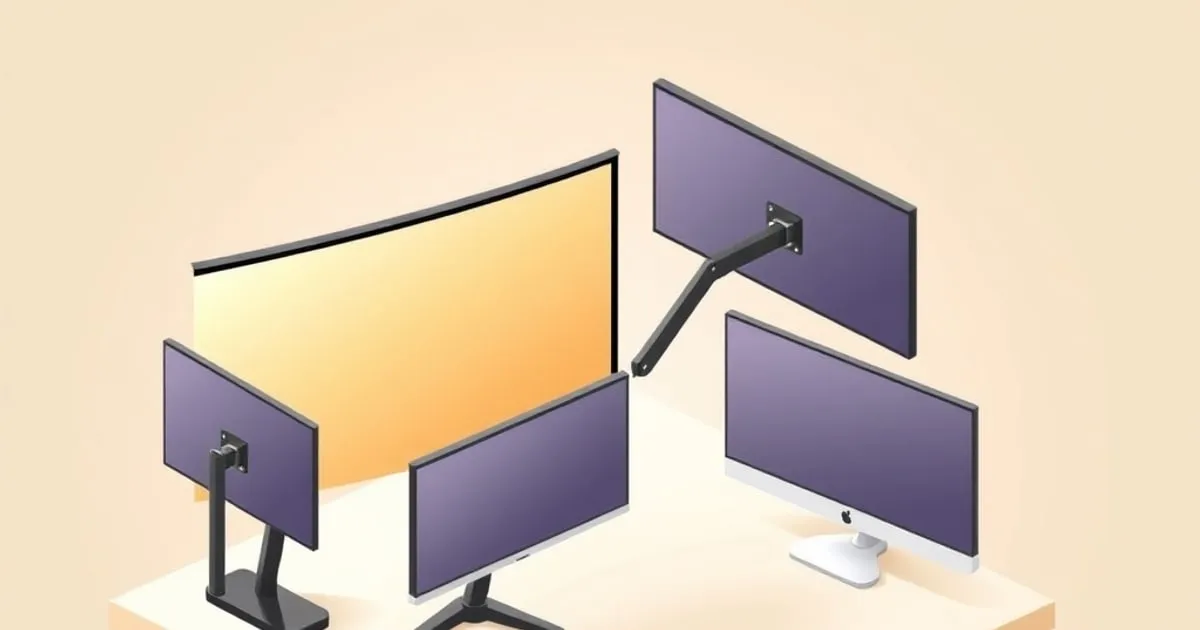
How Much Does a Monitor Weigh? Weight by Size
Most 24- to 34-inch monitors weigh about 7–22 lb without a stand. Compare manufacturer-listed weights for real 24- to 49-inch models.
This guide answers how much a monitor weighs with manufacturer-stated bare-panel figures organized by screen size and model. It covers 24- to 49-inch displays without their factory stands, which is the relevant load for VESA mounting. Once an exact panel weight is known, the separate monitor arm weight-capacity guide explains how to choose a suitable load range.
Monitor Weight by Size: Published Figures
Every figure below is the manufacturer’s own “weight without stand” or VESA-model weight, converted to pounds. These are real listed models, chosen because they sit at typical points in each size class rather than at the extremes.
| Size | Model | Weight without stand |
|---|---|---|
| 23.8 in | Dell UltraSharp U2422H | 7.8 lbs (3.52 kg) |
| 27 in | LG UltraGear 27GP850-B | 9.3 lbs (4.2 kg) |
| 27 in | Dell UltraSharp U2723QE | 9.9 lbs (4.48 kg) |
| 27 in | Apple Studio Display (VESA) | 11.9 lbs (5.4 kg) |
| 31.5 in | Dell UltraSharp U3223QE | 12.5 lbs (5.65 kg) |
| 34 in curved ultrawide | Dell UltraSharp U3423WE | 17.0 lbs (7.72 kg) |
| 49 in super-ultrawide | Samsung Odyssey OLED G9 (G95SC) | 20.3 lbs (9.2 kg) |
The pattern that matters for mounting: a mainstream desk monitor is lighter than people assume. The average 24-inch office panel is under 8 lbs, and a 27-inch is usually in the 9 to 12 lb band. Even a 34-inch ultrawide, the size that makes buyers reach for a heavy-duty arm, lands near 17 lbs, comfortably inside the range of a mid-tier arm.
Use these as bands rather than gospel:
- 24 inch: 7 to 10 lbs
- 27 inch: 9 to 14 lbs
- 32 inch: 12 to 20 lbs
- 34 inch ultrawide: 15 to 22 lbs
- 38 to 49 inch: 20 to 36 lbs
Anything you find far outside its band is usually a curved VA gaming panel with a metal chassis, or an older CCFL-backlit display.
Why the Stand Distorts Everything
The number printed on a retail listing is nearly always the weight with the stand, because that is what ships in the box. The gap is large and consistent:
- Dell publishes the U2422H at 3.52 kg without stand and 5.57 kg with stand and cables, so the stand accounts for roughly 4.5 lbs.
- Dell publishes the U2723QE at 4.48 kg without stand and 6.64 kg with stand, again about 4.8 lbs of stand.
So a “12 lb monitor” on a shopping page is frequently a 7.8 lb panel wearing a 4.5 lb stand. Size an arm off the box figure and you can end up two capacity classes too high, paying for a heavy-duty arm and then running a light panel below the arm’s minimum, which causes its own problems. That failure mode is covered in monitor arm drifting or sagging.
Where to find the honest figure:
- The user guide PDF, not the store page. Dell, LG, and Samsung all publish a specifications table with a “weight without stand assembly” row.
- Apple states it differently: the Studio Display is sold in a separate VESA-adapter configuration, and that model’s listed weight of 11.9 lbs already excludes the stand.
- Failing both, weigh the panel on a bathroom scale after removing the stand. Weighing the whole assembly and subtracting a guess is how people end up 5 lbs out.
Why Two 27-Inch Monitors Differ by 30%
Diagonal size is a weak predictor on its own. Four things move the number:
Chassis material. The Apple Studio Display is 11.9 lbs at 27 inches against the LG 27GP850’s 9.3 lbs, a 28% difference at identical diagonal, driven by an aluminium enclosure and a full sheet of glass instead of plastic bezels.
Built-in electronics. USB-C hub monitors carry an internal power supply capable of delivering 90 W or more to a laptop, plus an Ethernet controller and a USB hub board. The U2723QE is heavier than the gaming LG for exactly this reason, despite a similar panel.
Curvature and glass. A curved VA panel needs a stiffer backplate to hold the curve. Anti-glare etched glass adds more than a plastic matte film.
Panel technology. OLED assemblies are thin but are usually paired with a heavier heatsink and metal backing. The 49-inch Odyssey OLED G9 at 20.3 lbs is remarkably light for its footprint compared with an equivalently sized LCD.
The practical takeaway: never estimate weight from a monitor you saw once. Look up your exact model number.
Turning Weight Into an Arm Rating
Once you have the bare-panel weight, the arm spec follows a simple rule. Buy an arm rated to at least 1.5x your panel weight so the load sits mid-range rather than at the edge of the spring’s travel. The full reasoning, including why the minimum of a capacity range matters as much as the maximum, is in monitor arm weight capacity and the 1.5x rule.
Worked from the table above:
- A 7.8 lb 24-inch panel wants roughly a 12 to 20 lb arm. The Ergotron LX (Amazon Associates), whose range and drawbacks are broken down in the Ergotron LX review, covers 7 to 25 lbs. That puts this panel near the bottom of its range, which is workable, but a lighter-rated arm holds a small panel more precisely.
- A 9.9 lb 27-inch hub monitor is the LX’s sweet spot, sitting close to the middle of that 7 to 25 lb window.
- A 17 lb 34-inch ultrawide wants 25 lbs or more of rating, which is where the Ergotron HX (Amazon Associates) and its 20 to 42 lb range takes over. Sizing guidance for this class is in the ultrawide and heavy monitor arm guide.
- A 20.3 lb 49-inch super-ultrawide needs 30 lbs or more and an arm rated for the panel’s width, not just its mass. See best monitor arm for an ultrawide.
To check a specific arm against your exact panel weight, VESA pattern, and desk thickness in one pass, run the numbers through the Monitor Arm Fit Checker.
Weight Is Not the Only Limit You Hit
Three specs fail independently of mass, and a panel that passes the weight check can still be unmountable:
- VESA pattern. Larger panels commonly move to 200x100 or 200x200, and many arms ship a 100x100-only plate. The VESA compatibility guide covers the patterns and which adapters legitimately bridge them.
- No VESA holes at all. Several thin consumer displays, including Apple’s standard Studio Display configuration, have no mounting holes unless you buy the VESA variant. Workarounds and their limits are in how to mount a monitor without VESA holes.
- Desk and mount. A clamp has a maximum desktop thickness and a minimum edge depth, and a hollow-core desk can flex under a heavy panel long before the arm complains. Compare attachment methods in desk clamp vs grommet vs wall mount.
Weight on Multi-Monitor Mounts
A dual mount’s headline capacity is usually per arm, but the desk-side load is cumulative and lands on one clamp. Two 27-inch hub monitors at 9.9 lbs each is only 20 lbs of panel, yet the leverage of two arms extended to opposite sides puts far more torque through the clamp than a single 20 lb display would.
That is why per-panel weight, not total weight, decides the arm class, while total weight decides whether your desk and clamp are adequate. The tradeoffs between one dual mount and two independent arms are set out in single vs dual vs triple monitor arms and the configuration options in the dual monitor setup guide.
Add Everything Bolted to the Same Arm
The panel is rarely the whole load. Before applying the 1.5x rule, add:
- A VESA adapter or reinforcement plate, typically 0.5 to 2 lbs.
- A webcam and clamp light, another 1 to 2 lbs, all of it acting at the far end of the lever.
- A laptop tray or second bracket sharing the same post, which counts fully.
An 11 lb panel with a plate, a webcam, and a bar light is realistically a 14 lb load. That is the number to size against.
Quick Reference
| If your panel is | Target arm rating | Typical arm class |
|---|---|---|
| 7 to 10 lbs | 12 to 20 lbs | Light single, budget clamp |
| 10 to 15 lbs | 18 to 28 lbs | Standard single, LX class |
| 15 to 22 lbs | 25 to 40 lbs | Heavy single, HX class |
| 22 to 36 lbs | 40 lbs and up | Heavy-duty / ultrawide |
Related Reading
- Monitor arm weight capacity and the 1.5x rule: how to read a capacity range properly
- Monitor arm drifting or sagging: what goes wrong when the load misses the range
- How to choose a monitor arm: the full decision tree
- Best monitor arms 2026, ranked by spec: which arms cover which capacity bands
- VESA compatibility explained: pattern matching and adapters
Final Word
Look up the exact model’s weight without the stand, add whatever else bolts to the arm, and multiply by 1.5. Published figures put a 24-inch panel near 8 lbs, a 27-inch near 10, a 32-inch near 12.5, and a 34-inch ultrawide near 17. Those numbers are low enough that many buyers over-specify the arm, then encounter a light monitor that will not stay where they put it.
Related across the network
- Studio Monitor Size for Your Room: 5, 7 or 8 Inch: studiomonitorguide.com
Sources
- Dell UltraSharp U2422H / U2422HX / U2422HE User's Guide (weight without stand assembly)
- Dell UltraSharp 27 4K USB-C Hub Monitor U2723QE - Official Specifications
- Apple Studio Display - Technical Specifications (VESA mount adapter model)
- LG UltraGear 27GP850-B - Official Specifications (weight excluding stand)
- Dell UltraSharp 32 4K USB-C Hub Monitor U3223QE - Official Specifications
- Dell UltraSharp 34 Curved USB-C Hub Monitor U3423WE - User's Guide (weight without stand assembly)
- Samsung Odyssey OLED G9 (G95SC), model LS49CG954S - Official Specifications
- VESA Flat Display Mounting Interface Standards
Related

Monitor Arm Weight Capacity: The 1.5x Sizing Rule
A guide to matching a monitor's stand-free weight to an arm's minimum and maximum capacity using the 1.5x sizing rule and total attached load.

What Is VESA Mount 100x100? Pattern, Screws, and Fit
What is VESA mount 100x100: the 100 mm hole spacing, the M4 screw spec, how to confirm your monitor has it, and why the pattern says nothing about weight.

How to Install a Monitor Arm: Clamp, Grommet, VESA
Install a monitor arm in the right order: check the desk, fit the clamp or grommet base, attach the VESA plate, hang the panel, then tension the lift.