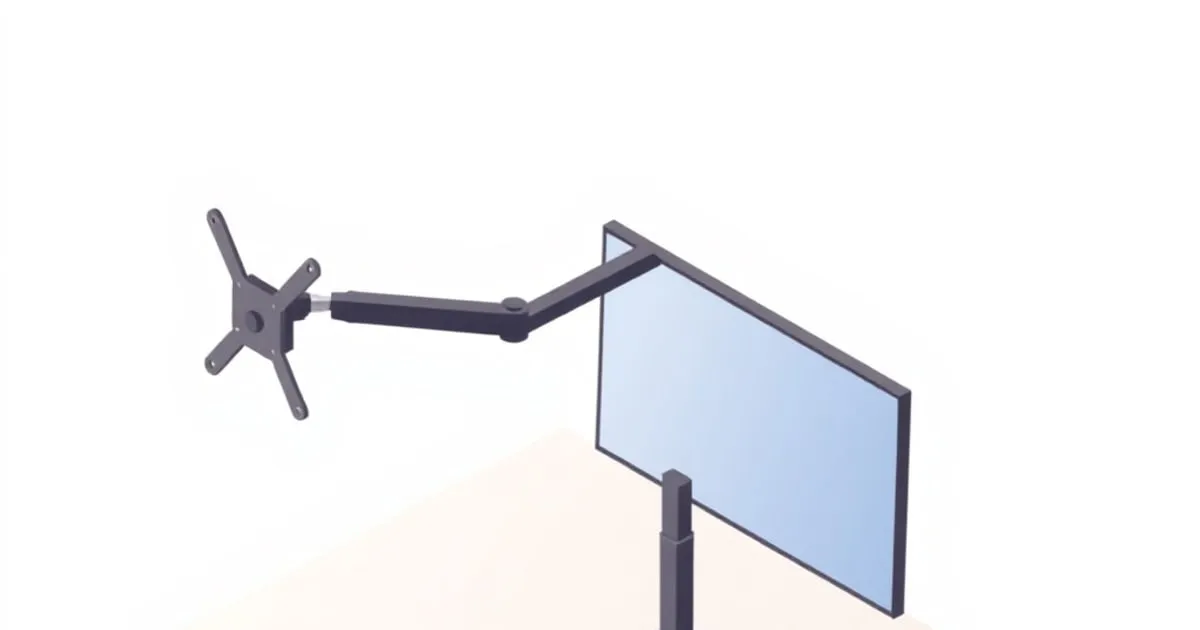
Best Monitor Arms 2026: Ranked by Spec and Capacity
Compare six monitor arms by published capacity, reach, VESA support, and warranty, with picks for standard screens, heavy panels, and smaller budgets.
A monitor arm supports a display from a desk or wall mount and lets you change its position within the arm’s adjustment range. It can replace a desktop stand when you need more height adjustment, different screen placement, or room where the stand’s base sits.
You need one when your existing stand cannot put the screen where you work comfortably or when you regularly reposition it. If your stand already supplies the right height and distance, keeping it is reasonable; see monitor arm vs monitor stand for that decision.
This guide ranks six monitor arms by published capacity, reach, mounting compatibility, and warranty information. The order is an editorial assessment of specifications. Start with the first model that fits your actual display and desk; no rank can make an incompatible arm suitable.
The ranking at a glance
| Rank | Arm | Published load | Reach or horizontal adjustment | VESA / fit check | Best use in this shortlist |
|---|---|---|---|---|---|
| 1 | Ergotron LX | 7–25 lb | Up to 25 in extension | 75×75 or 100×100 mm | Standard single-display setups |
| 2 | Ergotron HX | 20–42 lb | Check the exact variant’s drawing | Check the supplied plate and pivot | Heavy displays within its specified configuration |
| 3 | Ergotron MX | 14–30 lb | Up to 16.7 in extension | 75×75 or 100×100 mm | Heavier panels needing less horizontal extension |
| 4 | Herman Miller Flo | 4.4–15.4 lb in the cited product sheet | 22.9 in horizontal adjustment | Check the specified VESA attachment | Lighter panels with an office-furniture arm |
| 5 | MSI MAG MT201 | Up to 44.09 lb | Check the dimensional drawing | 75×75 or 100×100 mm | Comparing budget options for a heavier panel |
| 6 | HUANUO HNSS6 | Check the exact HNSS6 version | Check the matching manual | Listed for 13–32 in screens | A budget single-screen shortlist |
The Flo row describes the standard Flo in Herman Miller’s cited product sheet, not Flo Plus or Flo X. Likewise, LX and LX Pro are different products. Match the complete model name on a listing before using any row as a compatibility check.
For current model details, follow the manufacturer links in each pick below. Prices vary by finish, mount kit, and seller, so check the complete configuration instead of comparing a bare arm with a kit that includes its base.
How this ranking is built
Capacity comes first. Check the monitor’s weight without its stand plus any accessories carried by the arm. The monitor weight reference explains how to locate that figure. Both the minimum and maximum of a spring arm’s range matter: an arm can be too strong for a light display.
The optional 1.5x allowance in our monitor arm weight capacity guide helps compare headroom. It is an editorial shortlist rule, not a manufacturer requirement. A display inside the documented load range can still have restrictions on depth or travel.
Reach and height come next. The maximum extension is a hardware dimension, not the distance from your eyes to the screen. Compare the arm drawing with your proposed base position, screen depth, and eye line. A long arm can bring a screen forward; folded clearance determines how close it can sit to a wall.
Mounting compatibility is a separate gate. Confirm VESA spacing, screw requirements, and any approved adapters. Then verify the desk material, edge access, and thickness. A matching weight band does not establish any of those other conditions.
Warranty is a comparison factor. Read the current policy for the product and purchase channel. A warranty states coverage terms; it is not evidence that a particular arm will last a specified number of years on your desk.
1. Ergotron LX — the standard single-monitor pick
The Ergotron LX leads this shortlist for its documented adjustment range and straightforward single-display configuration. Its published specifications include a 7–25 lb load range, 13 inches of lift, and up to 25 inches of extension. Ergotron lists a 10-year warranty.
Read the load footnote before relying on all the vertical travel. Above 20 lb, Ergotron says movement may be reduced by up to 4.5 inches. That can matter when the screen needs to sit low.
The Ergotron LX review covers its dimensions and adjustment instructions. Check the original LX model separately from the LX Pro, and reject the LX if your configuration exceeds its documented limits.
Choose it for: a compatible single display when the published height and reach suit your desk.
2. Ergotron HX — the heavy-display pick
The Ergotron HX moves into a 20–42 lb load range. That makes it a candidate for heavier equipment, but its minimum rules out a light panel that would fit the LX.
The pivot and display depth also matter. Ergotron offers different HX configurations, including versions intended for deep curved panels. Do not assume that the standard and HD-pivot packages approve the same display just because the arm bodies look alike.
Use Ergotron LX vs HX vs MX to compare the three ranges. The ultrawide ranking addresses the heavy curved-panel buying decision, while the heavy-monitor geometry guide explains tilt torque and clearance.
Choose it for: a heavier display explicitly supported by the selected HX and pivot combination.
3. Ergotron MX — the shorter-reach specialist
The Ergotron MX has a published 14–30 lb range and up to 16.7 inches of extension. It is useful to compare when a panel exceeds the LX’s capacity but does not need the LX’s longer extension.
The shorter reach is neither universally better nor worse. Sketch the proposed base location and display position against the drawing. Also check its vertical adjustment range before assuming it substitutes directly for an LX or HX.
Choose it for: a compatible heavier panel whose intended position falls within the MX’s more limited reach.
4. Herman Miller Flo — the lighter-panel office option
Herman Miller’s Flo product sheet lists a 4.4–15.4 lb monitor range and 22.9 inches of horizontal adjustment for the standard Flo. Those figures describe a lighter-load option than the HX, despite the shared premium-office positioning.
Keep the family names separate. Flo, Flo Plus, and Flo X specifications are not interchangeable, and a listing should identify which arm and attachment it includes.
Read Ergotron LX vs Humanscale M2.1 and Herman Miller Flo for the comparison questions to ask across those families. Verify the exact variant against its manufacturer sheet when narrowing that comparison to a purchase.
Choose it for: a lighter display within the documented standard-Flo range, after checking mounting hardware and motion.
5. MSI MAG MT201 — a budget candidate for heavier panels
MSI’s MAG MT201 specifications list a maximum load of 20 kg, or 44.09 lb, with 75×75 and 100×100 mm VESA compatibility. That headline maximum makes it worth comparing for a heavier monitor at a lower purchase budget.
A maximum alone does not establish minimum supported load, tilt behavior with a deep curve, or desk fit. Consult the manual for the complete adjustment and mounting requirements. The MT201 and MT201W names should also be checked separately.
Choose it for: a budget comparison where the exact monitor and mounting arrangement meet MSI’s full documentation.
6. HUANUO HNSS6 — the budget single-screen option
The HUANUO HNSS6 listing identifies a single-monitor mount for 13–32 inch screens and links to its manual. Match the model suffix and supplied base to that documentation before using a seller’s weight figure.
Screen size is only the initial filter. Check supported load, VESA attachment, and desk thickness before treating an inexpensive arm as equivalent to another model.
Choose it for: a budget single-screen setup once the exact version passes the fit checks. The budget monitor arm guide explains how to compare the lower-price options with the LX benchmark.
Desk mount, wall mount, and multiple displays
A desk clamp needs a suitable accessible edge. A grommet kit needs a suitable hole and mounting surface. A wall mount needs the wall structure and hardware specified by its installation instructions. None is an automatic workaround for an unsuitable desktop.
On a moving desk, a desk-mounted screen moves with the desktop. A wall-mounted screen stays at the wall position unless adjusted separately. Use desk clamp vs grommet vs wall mount and the standing-desk arm guide to plan that arrangement.
For two or three screens, read the per-display limits as well as any total-system limit. Shared posts and separate arms give different positioning options. The dual monitor setup guide covers layouts, and single vs dual vs triple arm selection covers the hardware choice.
Before ordering
Confirm the model-specific load range, screen depth restrictions, VESA holes, and desk attachment. Then check that the screen can reach your intended position without the arm joints colliding with a wall or trapping cables.
The VESA compatibility guide covers holes and adapters. Displays without a standard interface need the checks in mounting a monitor without VESA holes.
Use how to choose a monitor arm for the full sequence and the Fit Checker for an initial screen. After installation, follow the manufacturer’s tension instructions; the drifting or sagging guide distinguishes movement at different joints.
FAQ
What is the best monitor arm in 2026?
The Ergotron LX leads this specification-based shortlist for compatible standard single-display setups. A heavier panel, lighter panel, deep curve, or different mounting requirement can make another model the appropriate choice. The ranking is conditional on the exact configuration meeting the manufacturer’s limits.
How much weight can a monitor arm hold?
Use the exact model’s published range. A minimum matters on a counterbalanced arm as much as the maximum. Include accessories supported by the moving arm, and follow depth and travel restrictions alongside the load rating.
Do monitor arms fit all monitors?
No. The supported load, mounting interface, required screws or adapters, and physical clearance must all match. Diagonal screen size cannot establish compatibility by itself.
Is an expensive monitor arm worth it?
Compare the documented adjustment range, mount options, warranty terms, and available replacement parts. Those differences can justify a higher price for your setup. Price alone does not show whether an arm can position your specific monitor correctly or how long it will last.
Sources
- Ergotron LX Desk Mount Monitor Arm — Official Product Page
- Ergotron HX Desk Monitor Arm — Official Product Page
- Ergotron MX Desk Mount Monitor Arm — Official Product Page
- Ergotron Warranty Policy
- VESA Standards (Flat Display Mounting Interface)
- OSHA Computer Workstations eTool — Monitors
- Herman Miller Flo Monitor Arm product sheet
- MSI MAG MT201 specifications
- HUANUO HNSS6 Single Monitor Mount
Related

How to Choose a Monitor Arm: A Spec-First Buyer's Guide
A buyer's guide for monitor arms: weight capacity, reach, joint type, mount style, and the compatibility checks that separate a good arm from a bad one.

Ergotron LX Review: Specs, Capacity, and Fit
A spec-based Ergotron LX review covering its 7–25 lb capacity, 34-inch limit, 25-inch reach, 10-year warranty, setup, and when to choose the HX.

Monitor Arm Weight Capacity: The 1.5x Sizing Rule
A guide to matching a monitor's stand-free weight to an arm's minimum and maximum capacity using the 1.5x sizing rule and total attached load.